
A conceptual postal artwork and archival performance (2025-)
Small objects carry national stories.
Great British Cover-Ups is a long-duration postal artwork examining how national memory is constructed, celebrated, and selectively edited. Using Royal Mail commemorative stamps and ordinary envelopes sent through the UK postal system, the project explores the tension between public commemoration and the less visible histories behind it.
The work takes shape through two editions.
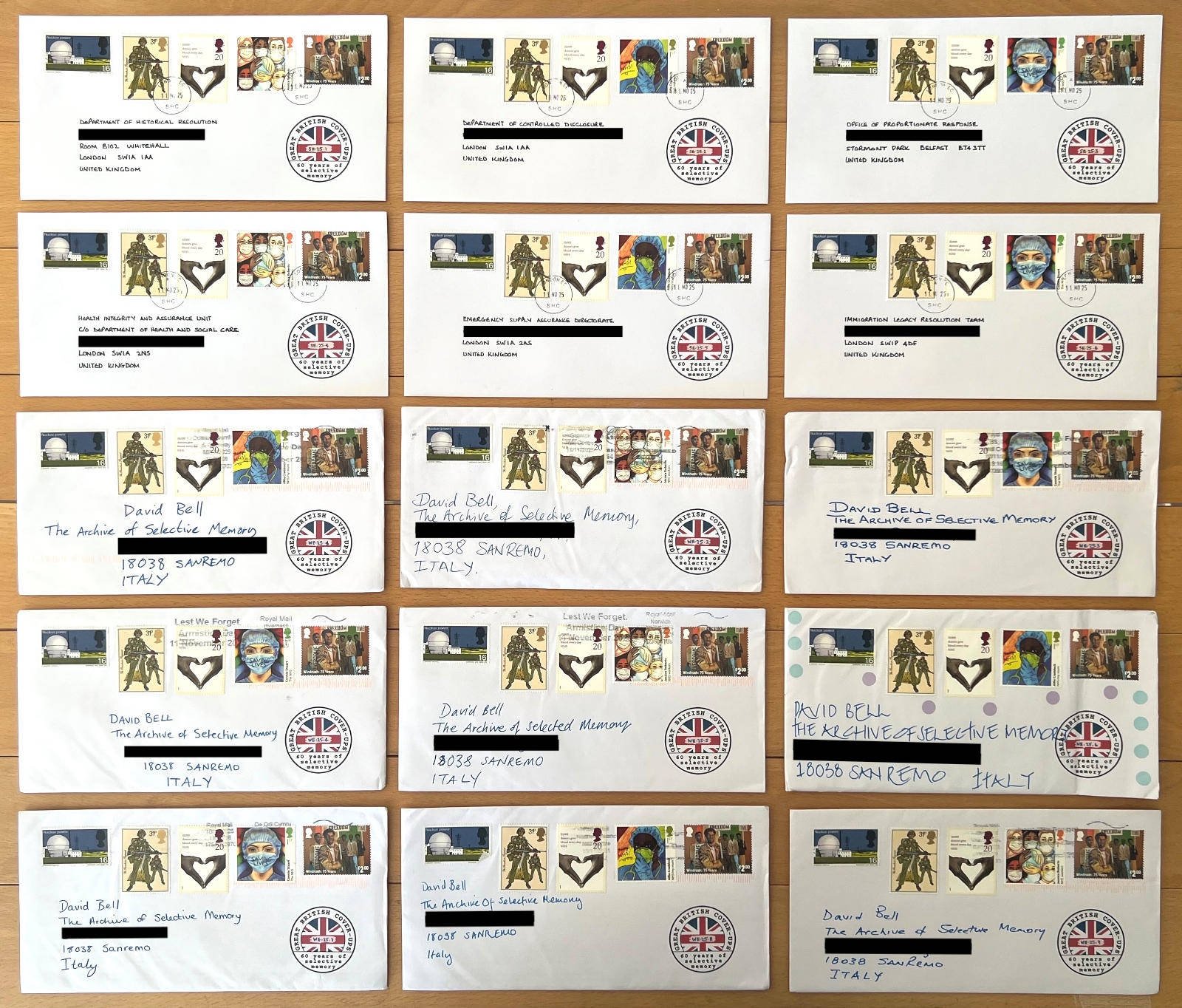
The Witness Edition was activated by nine participants who posted their envelopes from their own hometowns on Remembrance Sunday, each contributing a private and undisclosed act of remembrance.
The Silence Edition comprises envelopes sent from the Royal Mail offices in London on Remembrance Day, reflecting the role of central institutions in shaping what is noticed, acknowledged, or quietly set aside.
After travelling through the postal network, each envelope enters a ten-year sealed period within The Archive of Selective Memory.
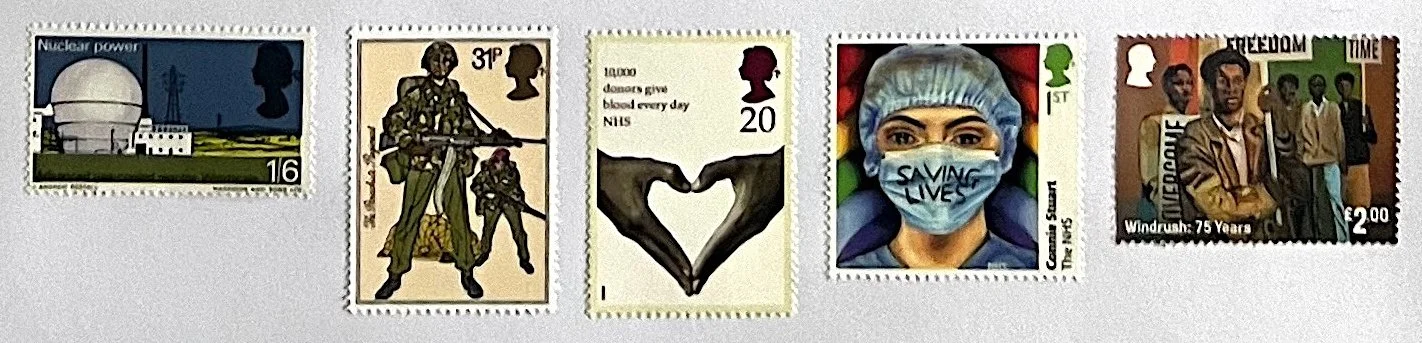
Each envelope bears a curated set of five commemorative postage stamps that, on their own, celebrate innovation, service, or national identity. Placed together on a single envelope, they cast a shadow over the cover-ups in which public truth, responsibility, or acknowledgement has been delayed or constrained.
The project focuses on five commemorative issues released between 1966 and 2023. Each celebrates a different aspect of national identity: nuclear progress, military history, public health, pandemic heroism, and migration.
Commemoration and Cover-Up
-
Issued to celebrate British innovation in nuclear energy. Now it exposes how ministerial zeal for more military-grade plutonium drove Windscale beyond its safety limits. In 1957, after the devastating fire in the reactor core led to the release of radiation across UK and Europe, Whitehall buried the Penney Report and scapegoated the very workers who had averted an even greater catastrophe.
-
Issued to honour the proud history of British military regiments. Now it confronts Bloody Sunday, 1972, when soldiers of the 1st Battalion Parachute Regiment killed 14 unarmed marchers and wounded 15 more in Derry, Northern Ireland. The march had been organised as a peaceful protest against internment without trial. More than fifty years on, no one has been convicted for the killing of British citizens on their own streets.
-
Issued to celebrate five decades of the National Health Service. Now it exposes the Infected Blood Scandal: More than 30,000 NHS patients were infected with HIV or hepatitis B and C - with over 3,000 dead - after officials imported high-risk plasma from the US and Austria, shredded safety files, and stonewalled a public inquiry for nearly forty years.
-
Issued to honour NHS workers on the pandemic frontline. Now it exposes the Covid Personal Protective Equipment (PPE) scandal: Government ministers squandered £9.9bn on unusable kit, fast-tracked politically connected firms with no PPE track record, and breached transparency laws by hiding the contracts. They fought to withhold evidence from the Covid inquiry and told coroners to steer clear of investigating systemic PPE failings. 850 health-care workers and nearly 46,000 care-home residents died.
-
Issued to celebrate Caribbean migration and the contributions of the Windrush Generation. Now it underlines the Windrush scandal: the Home Office shredded landing-card evidence, imposed a “hostile environment” and secretly expelled at least 83 lawful residents - hundreds more were detained, sacked from jobs or denied care - while, in 2025, the government still resists a full public enquiry.
Together, these commemorative images chart 60 years in which national celebration and institutional failure have been held in uneasy proximity.
Witness Edition
Remembrance Sunday - 9 November 2025
Each witness stands in for the public whose experiences rarely enter the official record, and whose perspectives are often absent from state narratives.
Nine witnesses posted an envelope on Remembrance Sunday, each from their own hometown in the UK. What they chose to enclose, whether material, ephemera, or nothing at all, remains undisclosed.
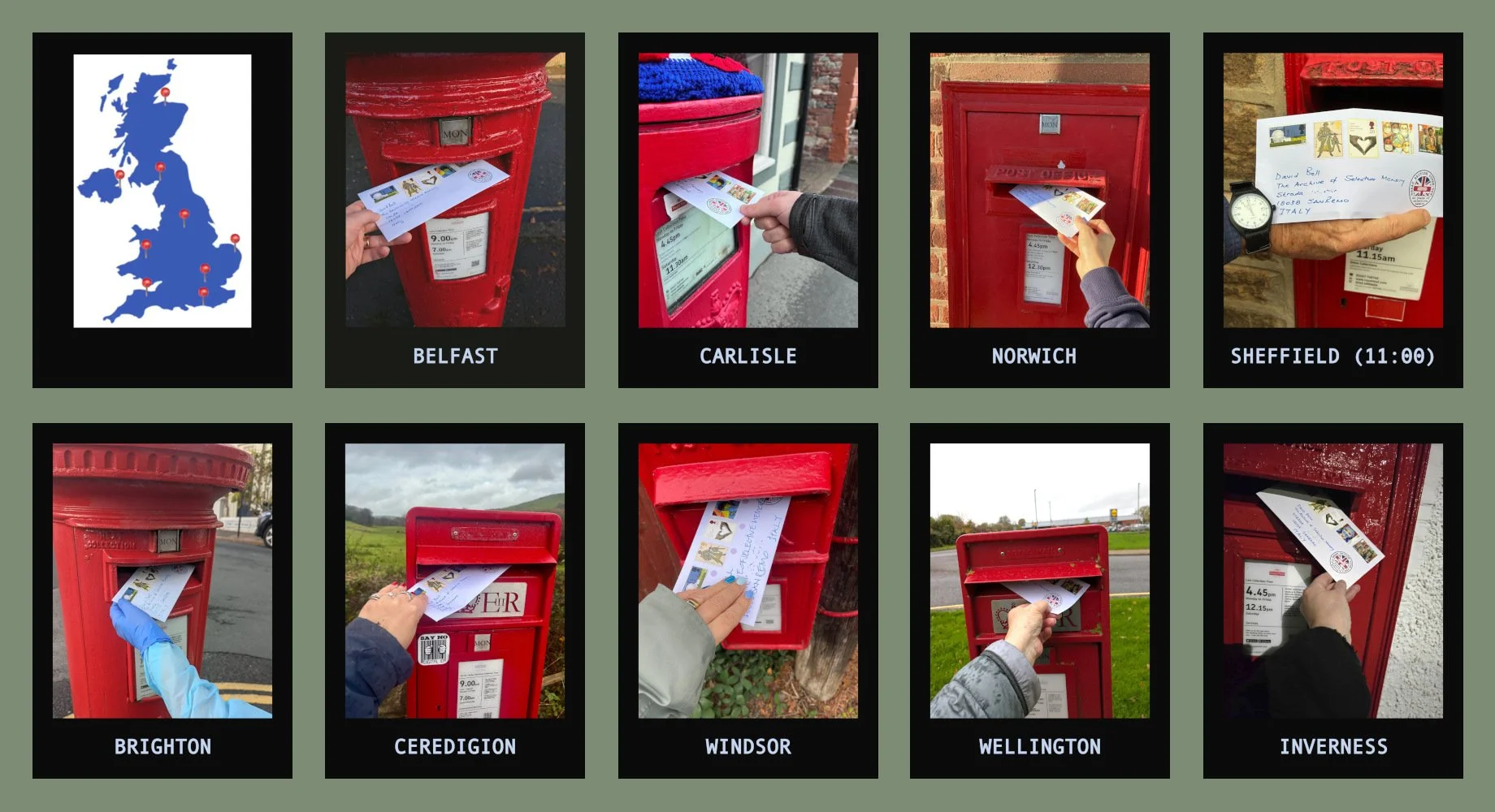
The curated stamp combinations draw attention not only to the graphic designs themselves but also to what they represent: the tension between national celebration and the histories that sit alongside it.
These envelopes have now been accessioned into The Archive of Selective Memory and will remain sealed until 2035, when their contents will be documented as part of the project’s final phase.
Silence Edition
Remembrance Day - 11 November 2025
A further six envelopes, containing no internal material, were processed on Remembrance Day at the Royal Mail stamping centre at Mount Pleasant, London.
Unlike the Witness Edition, these envelopes contain nothing. Their authority comes entirely from the postmark: an official gesture attached to an empty interior.
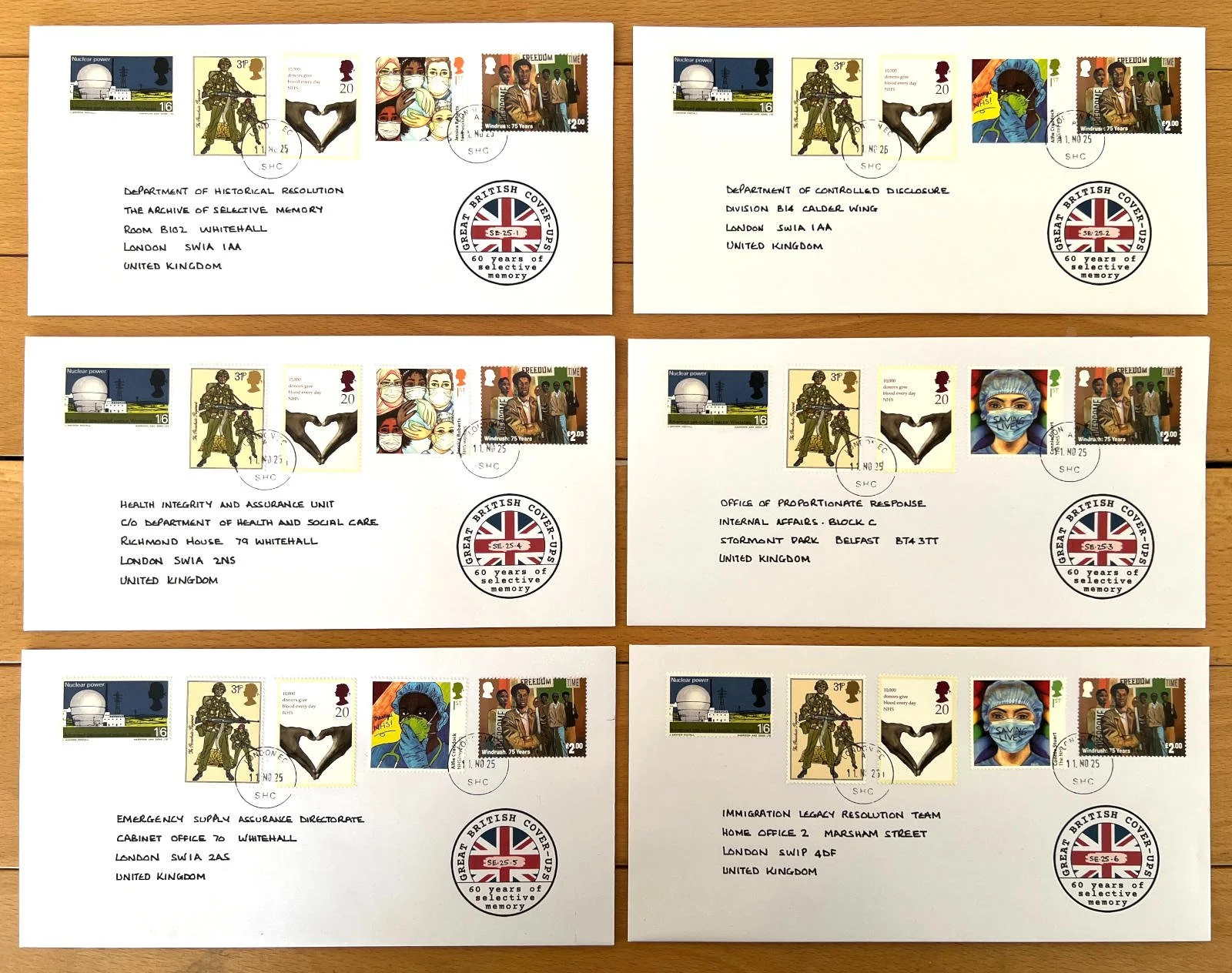
They now bear the London EC postmark, a district historically associated with national administration, official record-keeping, and state bureaucracy.
In the logic of the project, this official marking is contrasted with the deliberate absence of content inside the envelope.
Their emptiness becomes a record in its own right: a state-validated silence held in plain sight.
Each Silence Edition envelope has been accessioned into The Archive of Selective Memory and remain sealed until 2035.
All envelopes enter The Archive of Selective Memory under formal protocols:
Each is accessioned as a discrete archival record.
Only the exterior (stamps, postmarks, handwriting, and handling marks) may be examined before 2035.
The contents remain sealed until the project’s final phase.
This long-term structure mirrors the extended delays often associated with public inquiries and institutional acknowledgement.
Entry into The Archive of Selective Memory
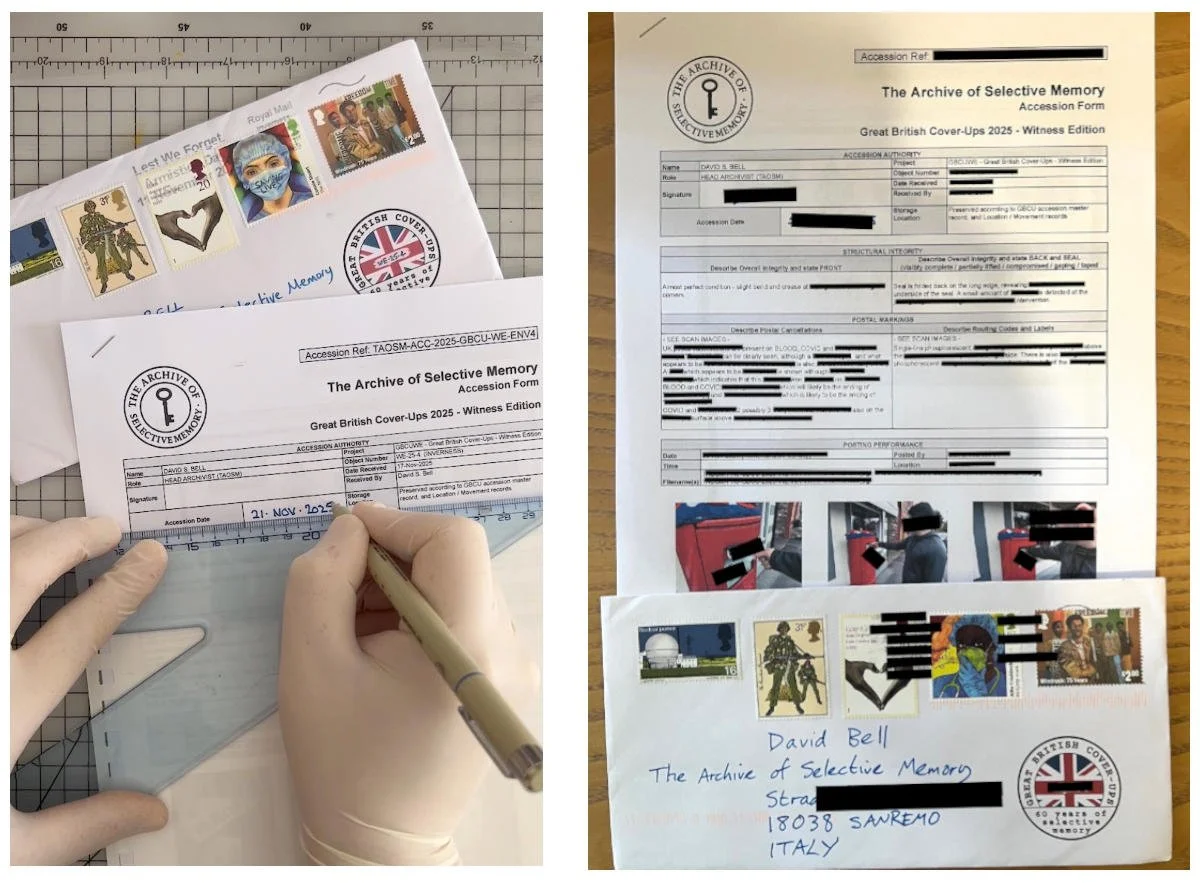
In accordance with the archive’s protocols, images of selected documents may be published with partial redaction, reflecting a tension between visibility and withholding.
Envelopes may be released (without redaction) for display and exhibition, but only as a complete edition to ensure the work is encountered in its intended collective form.
-
The project thanks, and acknowledges the good work of, the 9 witnesses of the Witness Edition: Aisling Spain, Allie George, Diane Goring, Nat Davy, Steve Meyfroidt, Viv King, and 3 more. Without them the concept would not have been possible.
-
Historical details in Great British Cover-Ups rely exclusively on established UK news sources. Assertions are drawn from documented investigations, official inquiries, and sustained journalistic scrutiny. All material is checked for evidential grounding; no unverifiable claims or speculative interpretations are included.
-
Stamps Design © Royal Mail Group Ltd., 1966, 1983, 1998, 2022, 2023.
The Photographs on this web page, the Great British Cover-Ups logo, and The Archive of Selective Memory logo are copyright © David Sidney Bell 2025 and may be used according to the terms of the CC BY-NC 4.0 license.
-
Essays relating to Great British Cover-Ups are published here: Essays
-
David Bell is a British artist based in Sanremo, Italy. His work examines memory, witness, and institutional silence. He is also Head Archivist at The Archive of Selective Memory.
www.davidbell.art / studio@davidbell.art